What a 3,000 lb forklift is worth
Running 3,000 lb units generally offer between $1,800 and $6,500 depending on condition, hours and brand. Tell us what you have and we will put a firm number in writing.
- Clean, low-hour 3,000 lb units reach the top of the range
- Non-running units bought at component value
- Every brand priced on the same scale
- Firm written offer in 24 hours
Offers in 24 hours · Paid at pickup · Transport included
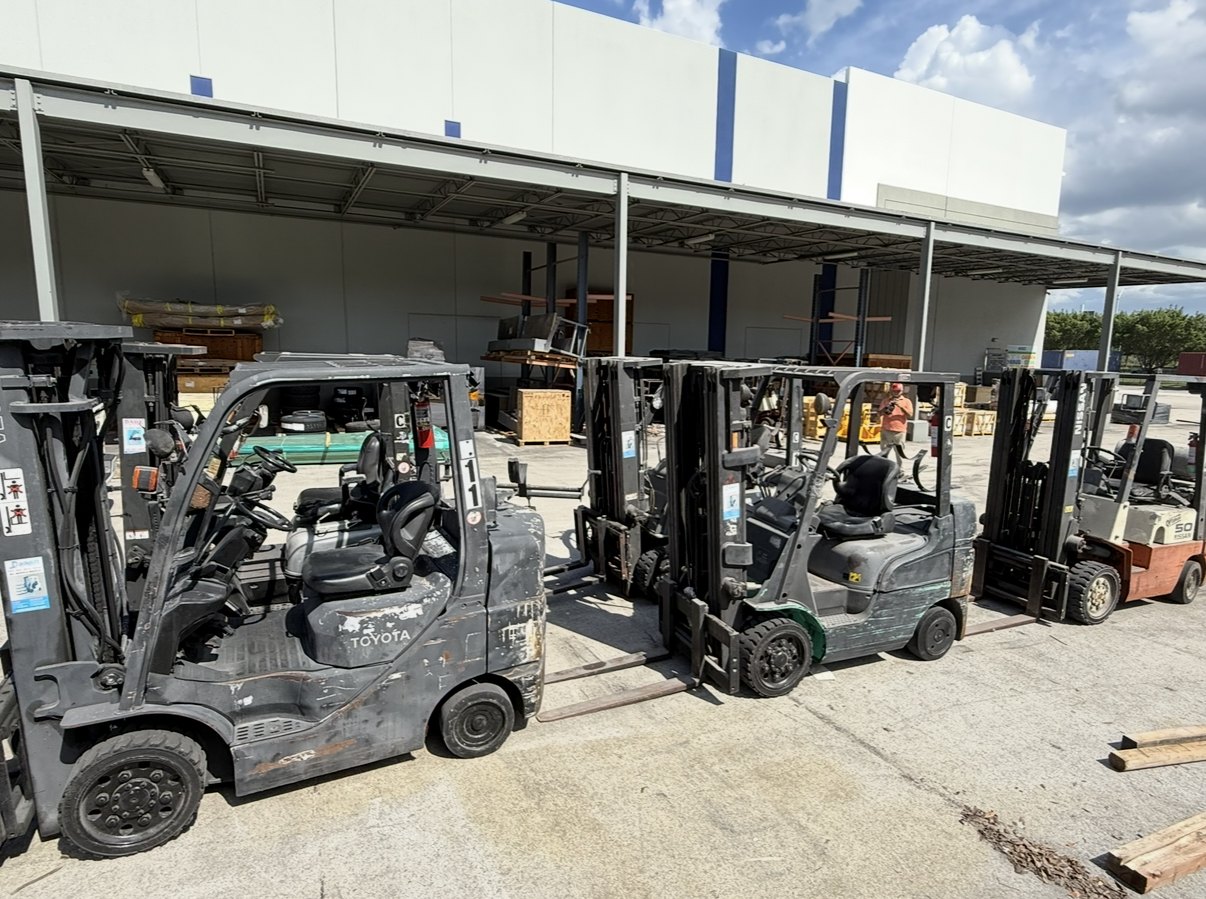
What 3,000 lb forklifts bring
These are offer windows we actually pay, not asking prices or book values. Condition, hours and brand decide where inside the range a particular machine lands, which is why the only number worth acting on is the one we give you after seeing photos of yours.
| Capacity | Running offer range | Common application |
|---|---|---|
| 3,000 lb ← this page | $1,800 – $6,500 | Light warehouse, retail backroom, single-pallet work |
| 4,000 lb | $2,400 – $8,500 | General warehouse, light manufacturing |
| 5,000 lb | $3,200 – $12,000 | The default American warehouse forklift |
| 6,000 lb | $3,800 – $14,000 | Heavier pallets, lumber, building supply |
| 8,000 lb | $5,000 – $19,000 | Steel, masonry, container unloading |
| 10,000 lb | $6,500 – $24,000 | Heavy manufacturing, pipe, precast |
| 15,000 lb | $9,000 – $34,000 | Mills, marble, heavy fabrication |
| 16,000 lb | $9,500 – $36,000 | Lumber mills, coil handling |
| 20,000 lb | $12,000 – $48,000 | Ports, steel service centers, rail |
| 30,000 lb and up | $18,000 – $95,000 | Container handling, shipyards, heavy industry |
Who buys 3,000 lb machines and why
Small frames are cheap to move, so we buy them in pairs or with a fleet more often than alone.
Light warehouse, retail backroom, single-pallet work. That application profile decides the resale audience, and the resale audience decides the number. Machines at this capacity move through dealers, rebuilders and export brokers, and the ones that sell fastest are the configurations buyers are already asking for — which is why an ordinary spec in good shape often beats an unusual spec in great shape.
Hours move the number inside the grade. Under 6,000 hours sits near the top of the range; over 15,000 near the bottom, unless the machine has been genuinely maintained and can prove it. Tire type, mast stage count, free-lift and any attachment on the carriage account for most of the remaining spread.
How the sale works
- 01
You send the basics
Brand, capacity off the data plate, hour meter reading, and whether it runs. Three photos help: full side view, the data plate, and the meter. Call or use the form — either works.
- 02
We price it the same day
Capacity, hours and condition set the range. Brand, tire type, mast height and attachments move it inside that range. You get a firm written number, normally within 24 hours.
- 03
You accept, we schedule
Pickup is typically two to seven business days out. We survey access from your photos first so the right truck and loading gear arrive the first time.
- 04
Paid on site, we haul it
Cash, certified check or same-day wire before the machine is loaded. Bill of sale is prepared by us. Transport is ours — it never comes off your number.
Four reasons owners take our number
We are the end buyer
Not a broker taking a percentage and not a dealer wanting a trade-in. We buy with our own money and take title, which is why we can commit to a number the same day.
Condition is not a disqualifier
Roughly a third of what we buy will not start. A dead engine lowers the number; it does not zero it out. Mast, carriage, hydraulics, drivetrain and frame steel all carry value.
Transport is on us
Quoted numbers already include freight. We bring the gear to load a machine with flat tires, a dead battery, or one parked behind racking.
Payment happens at pickup
Before the forklift leaves your property. No consignment, no waiting on resale, no retainage held back.
3,000 lb forklifts by brand
- Toyota forklifts
- Hyster forklifts
- Yale forklifts
- Caterpillar forklifts
- Crown forklifts
- Raymond forklifts
- Clark forklifts
- Nissan / UniCarriers forklifts
- Mitsubishi forklifts
- Komatsu forklifts
- Linde forklifts
- Jungheinrich forklifts
- Doosan / Bobcat forklifts
- Hyundai forklifts
- Taylor forklifts
- Big Joe forklifts
- Genie forklifts
- SkyTrak / JLG forklifts
3,000 lb forklift value questions
A running 3,000 lb unit in average condition generally offers between $1,800 and $6,500. A clean low-hour example can reach $6,500; a non-runner is usually in the $250 to $1,950 band. Hours, brand, tire type and attachments move you inside those ranges.
Yes. Small frames are cheap to move, so we buy them in pairs or with a fleet more often than alone. A dead engine or transmission lowers the offer but the mast, carriage, hydraulics, axle and counterweight still carry component value, with frame steel underneath as a floor.
Light warehouse, retail backroom, single-pallet work. Application matters to the offer because it predicts how the machine was worked — duty cycle and operating surface show up in mast wear, tire condition and drivetrain hours.
We come to you. Transport is arranged and paid for by us, and it is already included in the number we quote — nothing is deducted afterward. For a standard counterbalance forklift we send a tilt-bed or a lowboy; for a 20,000 lb and up machine we arrange the permitted load. You do not need a loading dock and you do not need the unit to be running.
Capacity, hours and condition set the range, then brand and tire type move it inside that range. A 5,000 lb LP cushion truck that runs well typically lands between $3,200 and $12,000. The same machine not running is usually $900 to $3,600. High-capacity diesel units run far higher. Our value guide has the full table by capacity and condition grade.
Yes, and it is a large share of what we buy. Non-running units still carry value in the mast, carriage, transmission, hydraulic pump, counterweight and frame steel. We bring the equipment needed to load a dead machine at no cost to you. What we need to know is why it stopped — fuel, electrical, engine, transmission or hydraulic — because that changes the number.
A verbal number usually comes in the first phone call. A firm written offer follows within 24 hours of receiving photos, the hour meter reading and the data plate. Pickup is typically scheduled within two to seven business days depending on where in the United States you are and how many units are involved.
Tell us what you have and take a number
Tell us what you have
Fastest route is a phone call — most owners get a number in the first conversation. If you would rather write it out, fill this in and we will reply within 24 hours.
(954) 740-1983